
How to Create a Game with an NFT Component
Even if you have no interest in cryptocurrency news and don't follow new tokens, you've likely heard about NFTs. It's like with Bitcoin: when a phenomenon's popularity reaches a certain point, it permeates all layers of the information space and attracts universal attention. At this stage, it no longer matters whether you're interested or not; knowledge will find you.
At the same time, the fact remains: you are already reading this article. So you are interested in NFT tokens, and moreover, you are interested in how to develop a custom NFT game.
NFT tokens have found applications in various areas of life. In 2021, the Hermitage launched a digital exhibition featuring 38 NFT projects available for purchase. Sales of tokens raised 32 million rubles. Twitter founder Jack Dorsey sold the NFT token of his first tweet for $2.9 million. Digital artist Mike Winkelmann received a record $69 million for a single NFT artwork.
So what is happening? What is NFT, and why is everyone talking about it?
What is NFT?
NFT stands for non-fungible token, i.e., a unique, non-replaceable token. Like cryptocurrencies, NFT tokens emerged from blockchain technology. But unlike, for example, Bitcoin, each NFT is unique and has its own value. While a traditional cryptocurrency unit is indistinguishable from another of the same kind (e.g., one Ethereum (ETH) is no different from another; it can be exchanged for any ETH without loss), NFTs are built on the opposite principle. To understand this, let's start with the environment in which NFTs exist—the blockchain.
Wikipedia states that a blockchain is a continuously growing list of records, called blocks, which are linked and secured using cryptography. Simply put, it is a database that is simultaneously stored on many computers. In the traditional Internet model, all devices connect to centralized nodes—Internet service provider servers. Blockchain works differently. It has no central nodes. Instead, all devices simultaneously store information published on the blockchain.
Tokens, in turn, act as entry points to the blockchain. They are units of asset accounting, similar to shares on a stock exchange. An important feature of most tokens is their adherence to the principle of fungibility. Because of this, they can be compared to traditional currency: one US dollar or Bitcoin can be easily replaced with one US dollar or Bitcoin owned by another user without loss of value.
But not all digital assets are built on the principle of fungibility. A unique object—such as a painting by Leonardo da Vinci—cannot be identical to a painting by Paul Gauguin, even if they are valued at the same amount in traditional currency. To transfer unique elements via blockchain, the format of non-fungible tokens was developed.
Each NFT is unique and exists in a single version; it cannot be divided. All information about its author, buyer, and the complete transaction history is securely stored in the blockchain. In other words, an NFT is a digital certificate linked to a unique object. Each NFT can have only one owner.
NFT Token Standards
Each blockchain has several standards that can be considered templates for functions used in smart contracts. Smart contracts are self-executing code blocks stored on the blockchain. Each standard offers a specific set of functions and attributes that need to be filled when creating an NFT token.
Ethereum
The ERC-721 standard, built on Ethereum, became the first standard for non-fungible tokens. It remains the most popular blockchain platform for creating and launching NFT tokens. The standard implies that each unit has attributes or characteristics that make it unique and rare.
Among other standards for NFTs used on the Ethereum blockchain, we can highlight ERC-998 and ERC-1155. They are largely similar to ERC-721 but can contain both fungible and non-fungible tokens simultaneously. This allows extending the standard's functionality: for example, ERC-1155 tokens allow users to register fungible (ERC-20) and non-fungible (ERC-721) tokens using the same address and smart contract. This feature can be useful in video games for storing fungible in-game currency and unique collectible items in a single secure account.
Other token standards are emerging on Ethereum, such as ERC-1190. This new standard, which allows developing multifaceted and complex NFTs, has already been submitted for consideration and is awaiting approval.
Flow
Flow owes its existence to the popular game CryptoKitties. This NFT-based game allows users to buy, sell, collect, and breed digital cats. The game launched on ERC-721 tokens. It became so popular that it began consuming more resources of the Ethereum blockchain than its creators anticipated.
The Dapper Labs development team solved this problem by launching a new blockchain called Flow. It was specifically designed to store collectible crypto items and video games built around owning these items.
Smart contracts on the Flow network are written in the Cadence language. Flow allows the use of upgradeable smart contracts. These smart contracts can be launched in beta version, then receive sequential upgrades like regular games and programs until the authors are satisfied with the result.
Tezos
Tezos is a multifunctional decentralized blockchain platform with support for smart contracts and the ability to create tokens and decentralized applications. Tezos uses its own cryptocurrency called Tez, and its own standard for unique tokens, FA2, which provides more capabilities in managing in-game assets.
Other Blockchains
There are other blockchains that support unique tokens, such as Palm and Solana.
The Palm blockchain is a token-based NFT ecosystem connected to Ethereum. It differs from competitors in its lower gas price (used to evaluate transaction fees on Ethereum) and faster transactions. Palm's main goal is to build an NFT ecosystem for cultural and creative development.
Solana is the world's fastest open-source blockchain and the fastest-growing cryptocurrency ecosystem with thousands of unique projects. Solana aims to leverage revolutionary technologies to launch a new generation of dApps (to learn more about dApps, just keep reading).
What are NFT Games?
NFT games are entertainment products built on the blockchain that contain digital objects—unique tokens. In games, NFT technology can be used as a means to attract investment. Players can create, buy, or sell tokens of any game objects, thus supporting game developers. For example, NFTs can be used to tokenize user skins, artifacts, weapons, and other game elements.
We have already discussed special token standards for video games—such as Ethereum ERC-1155. Not only developers but also users can benefit from the introduction of NFTs. For example, in games based on such a standard, users can sell their game NFT tokens to other players and collectors, earning cryptocurrency and increasing their wealth.
NFT games are primarily offered on the Ethereum platform. To start playing, you usually need to make a small investment—for example, purchase an in-game NFT object to play with: fight monsters, tend a garden, care for a virtual pet. By playing with the purchased item or character, you increase the token's uniqueness. Later, it can be sold to another player or collector at a higher price.
Some games require no initial investment and operate on a partially free model. They typically use the pay-to-win system popular on smartphones. You can play without investing, but certain paid items significantly speed up gameplay, making the game more engaging. Players have a choice: buy recommended items to ensure victory, or rely on their own patience and luck for free.
For example, you can start without investment and develop your character by performing certain actions. Over time, the character's value increases. Additionally, most such games include mechanics that allow earning in-game bonuses: token distributions within the game, prize competitions, etc.
The key advantages of developed NFT games are the ability to earn real money, monetize gaming experience, and develop the blockchain ecosystem.
There are also drawbacks: you need to invest in these games, earnings depend on cryptocurrency and sales of game objects. Additionally, there are risks. Players must constantly upgrade characters and often have to regularly buy paid items to keep winning.
On the other hand, demand for upgraded characters often exceeds supply, so players can recoup all past investments many times over in a single transaction. For example, the most expensive monster from the NFT game Axie Infinity was sold for $1,076,100.
How to Develop an NFT Game: Preparation Stage
How to implement NFT principles in a gaming environment? To create and use NFT tokens within games, developers create smart contracts with special rules for token handling.
For example, in CryptoKitties, the game is built on a small number of key contracts. The most famous one, geneScience, determines random mechanics for generating new cats.
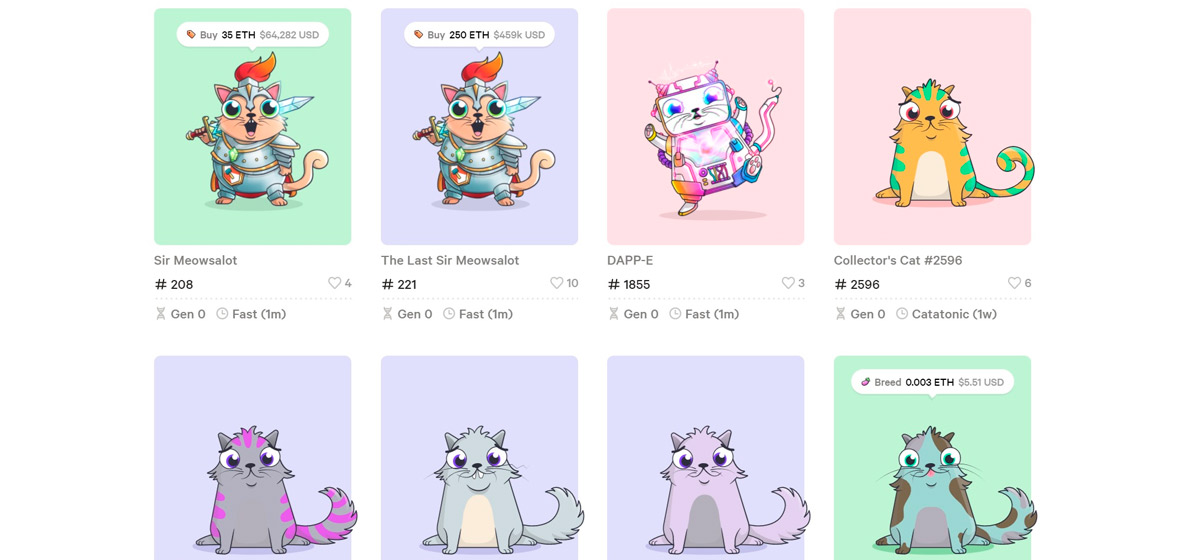
Initially, the game developers kept the geneScience code secret, so interested players created their own tools to calculate the probability of new kittens inheriting certain traits. This helped users increase their chances of getting a rarer and more valuable breed.
Now let's discuss in more detail how to develop and create an NFT game.
Game Model
All NFT token games can be divided into two large groups:
- P2E (pay-to-earn). To start playing, the user must purchase their first NFT in the game system. In the future, this investment can be recovered—and even yield profit. Many P2E games allow gamers to earn so-called utility tokens, which can be used to buy NFT tokens for characters, abilities, or upgrades.
- F2P (free-to-play). There are far fewer NFT games of this type, but they have one big advantage. There are no upfront costs: new users can immediately start playing. However, earnings in this case will be lower. Such games may not have their own utility tokens.
The utility token method is considered more stable in terms of user earnings than the NFT method, where obtaining valuable NFTs depends purely on luck.
To help new players who cannot afford to pay for entry or are afraid to invest real money, scholarship funds are organized based on games. Experienced users sponsor and train newcomers, and in return receive a fixed share of their future earnings.
Game Design for an NFT Game
The first thing to do is choose a genre for the future game. An NFT game is not some unknown monster existing in another dimension. It is a game like any other, but with special characteristics. Will your game be a strategy, action, adventure, simulator, RPG, or card game? There are no limits; all options are available.
After choosing a genre, conduct competitor analysis. Find similar games on the blockchain and beyond. But don't blindly copy popular games, creating clones: take what makes those games successful and add your own ideas and mechanics to create a unique product.
All information about the game should be recorded in a design document. This way you will never forget anything and avoid misunderstandings or interpretation errors when working with the development team.
Once you define the key stages of the game, understand the characters, upgrade system, win conditions, and monetization, you can move on to designing and developing game graphics.
Of course, design in video games is a field open to diverse creativity. You can work in any direction that seems most appealing. But consider one point.
The most popular NFT game currently is Axie Infinity. In this game, all gameplay revolves around collecting fantastic NFT animals that can be sold or bred to create new unique species.
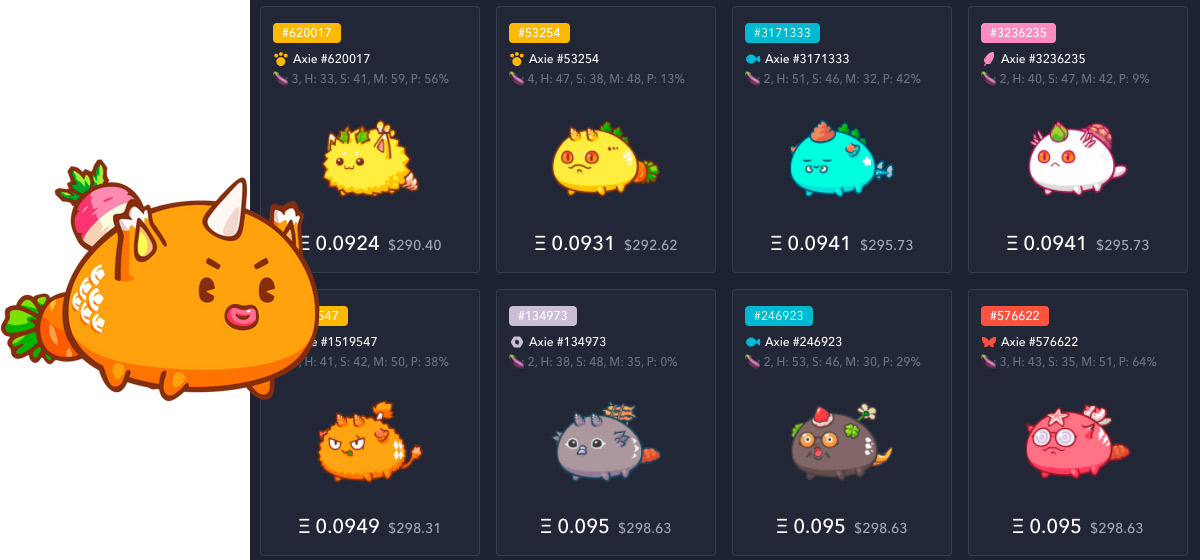
Another popular NFT game, CryptoKitties, also builds on the mechanics of breeding cute digital characters. Both of these games combine bright, cartoonish graphics with cute animals. Almost no one can resist cute animals. This doesn't mean you need to launch the same game with the same mechanics; just keep this in mind when working on the design.
Other popular NFT games span different genres, but they all have something in common: they are not AAA games with cutting-edge graphics. Major gaming companies are already planning to merge AAA games with NFT functionality. Unfortunately, the effectiveness of such a combination has not yet been tested and remains highly questionable.
To avoid risks and not invest huge sums in an untested concept, start with more modest graphics. Later, when you understand the specifics of NFT games and see firsthand how audiences react, you can move on to games with more complex and advanced design.
Platform: Decentralized or Mobile Game?
Applications built on blockchain technology are called dApps, i.e., decentralized applications. The core code and data (backend) of decentralized applications are stored and executed on a P2P blockchain, unlike applications operating on a client-server model where data and code are processed on external servers.
In fact, all existing cryptocurrencies can already be considered types of decentralized applications. But they are usually considered the foundation of the blockchain, on top of which various decentralized applications operate.
Most decentralized applications are delivered as open source, meaning any user can read the code and see how different features are implemented in the application.
Let's continue exploring how to develop your own NFT game. Before starting game development, you need to answer one big question: how will the user interact with your game? Through a browser tab, or a mobile app?
Both options are viable. A web application is universal: it can be launched from any device with a browser, from a computer to a smartphone, anywhere in the world. On the other hand, mobile applications run much faster on smartphones and can contain more additional features. As a result, developing such applications and games requires more time and investment.
Mobile games can be native or cross-platform.
- Native applications are developed specifically for a particular operating system, allowing them to access various smartphone functions: camera, contact list, GPS sensor data, etc. Most native apps are developed for Android and iOS, but there are other platforms such as Blackberry, Windows Mobile, Symbian, Bada, as well as open-source systems like Mobian and Ubuntu.
- Cross-platform applications cannot use smartphone functions for gameplay. However, they are much simpler, faster, and cheaper to develop, as you only need to create one version that works on all operating systems instead of 3-5 versions.
Before choosing between native and cross-platform applications, decide whether you will use unique smartphone functions within the game. Also, note that the AppStore has its own strict set of criteria that every application and game must meet. If all requirements are not considered, the store may simply refuse to add your developed game to the catalog.
Another option is to develop a hybrid application that works both as a mobile app (for phones) and as a web app (for browsers). If you choose this route, consider Progressive Web Applications (PWAs). This format allows you to run the app using a browser on a smartphone. At the same time, such an app retains almost full native format functionality. Additionally, the app does not need to undergo AppStore acceptance testing and go through all the hurdles of audit checks.
Advantages of developing hybrid games:
- Push notifications (on all platforms except iOS devices).
- Ability to use the app offline.
- Access to some smartphone functions (except iOS devices).
- Ability to place an icon on the smartphone screen that looks no different from a native app icon.
For a fully informed decision, define your target audience and find out what devices your future players prefer. Depending on the genre, this may require additional investment in preference research.
The simplest option for developing a first game with NFT tokens is to build the gameplay within a web application. This format provides maximum coverage and is not limited to a short list of branded devices. Additionally, it requires neither complex technological feats nor compliance with a lengthy list of platform-specific rules.
Development Technologies
To start your journey as an independent NFT game developer, leverage the advantages of open source. For example, on GitHub, you can find many ready-made games and templates that can be used to develop with the specifics of such games and their unique mechanics.
If you are far from GitHub, start getting to know it now, because you will definitely need it in the future. GitHub is the most famous project management and collaborative development system. It allows you to work with people from around the world, plan projects, and track results.
One of the most common ecosystems for developing decentralized applications is Truffle Suite. It is the leading environment for smart contract development. Truffle tools are used by giants like Microsoft, Amazon, and VMWare. Truffle Suite provides blockchain developers with a standardized testing environment. The development package includes a wide range of tools for creating reliable, high-quality smart contracts.
Truffle Suite consists of three different parts:
- Truffle. A development environment that uses the Ethereum Virtual Machine and specializes in smart contract development, management, and testing.
- Ganache. A tool for setting up a local Ethereum blockchain that allows you to deploy, develop games, and test all decentralized applications in a secure deterministic environment.
- Drizzle. A set of front-end libraries based on the Redux store, used to develop more predictable and user-friendly interfaces.
For a long time, Truffle Suite only supported blockchains based on Ethereum or the Ethereum Virtual Machine. However, Truffle recently announced support for Tezos. This is the first blockchain outside the Ethereum Virtual Machine to receive Truffle support.
Among other platforms for developing decentralized applications, Moralis should be highlighted. This platform has an infinitely expandable server infrastructure, eliminating the biggest obstacles in developing decentralized games and applications.
Moralis offers developers a fully managed backend infrastructure. This means that instead of debugging the backend, you can fully focus on developing the frontend and user interface—that is, what makes the game a game.
Front-End Development Stage
The front-end—the client side of the user interface—can be written in JavaScript. You will also need to choose a framework, a ready-to-use set of software solutions that includes design, logic, and basic functionality of a system or subsystem.
A framework contains predefined and implemented classes or functions. Additionally, for specific tasks, you can add your own code to what is already in the framework.
Worthy framework options are React and Vue. The Angular framework, with its huge software interface, would be too complex and confusing for beginners. Truffle Suite was originally designed to work in tandem with React, but since 2019, a plugin for Vue is also available to users.
The front-end can be hosted on the Netlify platform. It is one of the most advanced web development platforms that helps programmers publish their projects online.
This is an ideal choice for small teams or solo developers who do not have the resources or capabilities to create their own infrastructure but want to share their projects on the internet. Moreover, the platform is completely free.
Storing Funds
Unlike regular money, cryptocurrency is not stored in a real or virtual wallet. It resides directly in the blockchain ecosystem. A crypto wallet is special software or a device that allows you to store cryptocurrency and perform various actions with it.
A crypto wallet must have a high level of security. To choose a suitable wallet, first visit the website of the cryptocurrency you will store and review the list of recommended applications. Every reliable wallet must meet the following requirements:
- have private and public keys;
- use multiple levels of security.
For example, CryptoKitties uses the non-custodial wallet MetaMask. It works as an extension for the Google Chrome family of browsers.
Smart Contracts
We have already mentioned that smart contracts are programs stored on the blockchain that execute when certain conditions are met. If a user wants to access their NFT tokens, it works like this:
- The front-end gets the user's address from the crypto wallet.
- The front-end sends the user's address to the smart contract.
- The smart contract gives the user the address of their NFT.
To work with smart contracts, you can use the official blockchain library called Web3.js. Web3 allows you to abstract away the internal mechanics of Ethereum and work with the network and smart contracts as if they were ordinary JavaScript objects.
The Solidity programming language is used to create smart contracts. Solidity is a Turing-complete language, meaning you can use it to create complex contracts in a well-defined code format.
All state changes are saved in an immutable form. Thus, before sending a contract to the application environment, you need to allocate enough time for testing. Bug fixing consumes a lot of resources and can cause critical system errors.
Smart contracts have the following important properties and advantages:
- Transparency. Blockchain users can read and use smart contracts via API.
- Immutability. When a smart contract executes, logs are generated that cannot be changed.
- Distribution. The contract's result is verified and confirmed by multiple nodes in the network. Information about contract status is publicly available. In some cases, even private variables can be viewed.
Back-End Development Stage
So, we have already determined that smart contracts work with the network address of NFT tokens. Using the address, the front-end can send a request to the back-end and receive metadata for the token. The back-end sends the metadata to the front-end. This includes the token's name, address, and identifier.
After receiving the data, the front-end can send another request to the server using the NFT address. The interface can then display the available data, and the user will see the NFT's name and images.
For the back-end, you can use node.js. This platform translates JavaScript into machine code that runs on servers. Thus, you can use JavaScript for back-end development.
Testing Stage
To test an NFT game, you can use special test blockchains, such as Rinkeby. Additionally, you can create your own blockchain for testing using Ganache on Truffle. Testing phases depend on the specifics of your game. Here's how it might look in practice:
- Functional testing. This is a test of the developed game's operability, data transfer, block and chain sizes to determine technical requirements, processes, etc.
- Security testing. A mandatory phase where the developed game is checked for vulnerabilities.
- UI testing. User interface testing is necessary to ensure all functions work correctly and nothing distracts from the gameplay. This stage checks fonts, colors, graphics, and other elements that make up the gaming experience.
- Integration testing. A functional test of the interconnections between various program components.
- API testing. The final stage is checking communications between software components and the external interface of the application. This stage confirms that all requests and responses are correctly processed by the system.
Conclusion
Now you have a general idea of the stages involved in developing an NFT game. The most important thing is not to get lost in the variety of NFT tools, but to focus on the value they will bring to the player. Will players want to buy your tokens with real money, and what will motivate them?