


Soft Launch Scenarios
The developer has just started soft launch and expects the first numbers in a few days. First and foremost, they expect Day 0 numbers, looking at first session engagement metrics such as session length and number of sessions.
I have not seen a single developer get stuck on Day 0 engagement metrics. They all continue to move towards gathering Day 1 retention metrics. But this is where many developers often hit a wall.
Working with dozens of developers in mobile games, I've seen that it's often hard to convey to the player what the next steps are. When there is no proper system to follow, the responsibility for following best practices can become an uncontrolled action.
Since we don't have a proper system for setting up and approaching soft launch, I have created scenarios to help developers understand where they are in the soft launch phase and develop approaches for different scenarios.
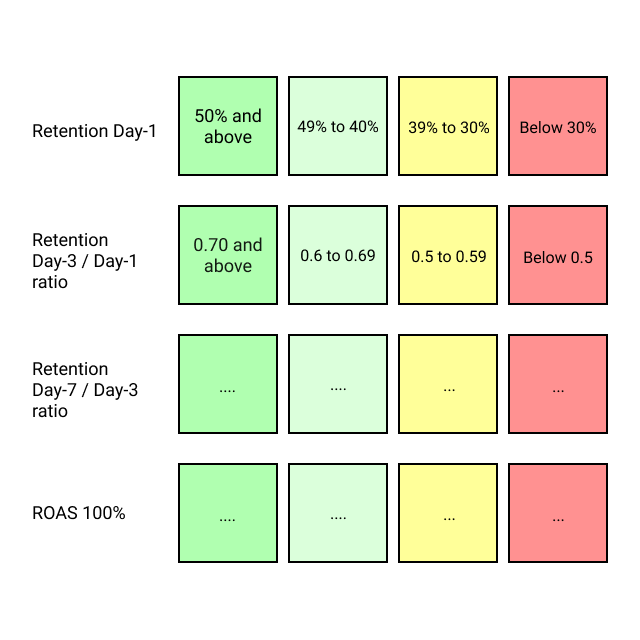
I will give an example of how to approach improving Day 1 retention. The developer launched their game, and they have enough players (a few hundred) to get statistically significant Day 1 retention numbers.
Dark green means you're doing very well.
Approach for this scenario: You can move on to the next metric to improve.
Light green means you're doing well, but there is room for improvement.
Approach for this scenario:
- Use analytics to figure out what players are doing differently than they should. Improve FTUE, look at the App Store funnel with Geeklab, try AB testing some important core gameplay things, like changing the game's difficulty.
Yellow is questionable and means you still have a lot of work to do.
Approach for this scenario:
- Many things may be wrong in the game. The developer needs to go into full curiosity mode and ask what's wrong with the game? There are qualitative and quantitative ways to find out what's wrong.
- Quantitative (analytics) What's similar about players who return on Day 1? What about players who don't return? Look at these groups of players. What do they do in their sessions? Are they playing the game you intended them to play?
- Qualitative (non-analytical) Compare your game to competitors, conduct playtests.
- Consider major changes, like switching from real-time to turn-based, from portrait to landscape, changing the game theme from fantasy to modern warfare. (For theme change, of course, test it first with tools like Geeklab).
- Conduct a Pixar BrainTrust, invite fellow developers (even from outside the company) to look at the game, share top takeaways on how players are playing the game, and ask them to contribute their ideas on what's wrong.
Red is either a lot of work or careful consideration of whether the game deserves further work.
Approach for this scenario:
- In this case, when Day 1 retention is below 30%, developers could ask themselves why low retention wasn't obvious during playtests? Why did they need to launch the game to get these numbers?
- You can use a similar approach as in the yellow scenario. However, increasing Day 1 retention by twenty percentage points is no easy task. You need to assess the opportunity cost and consider killing the project.
- Whatever you do, the team must eliminate the most plausible reason the game isn't working. Otherwise, the team risks repeating mistakes and not learning from the failure.
Applying the Scenario Model
You can play with the scenarios. Maybe in your game category, Day-1 needs to be above 55% to be dark green. Or maybe Day-1 at 30% is fine for you, because you know these players will stick around on Day 7 and Day 30, and you can start focusing on other metrics.
You can develop your own innovative approaches to scenarios, both on the quantitative and qualitative side. Player surveys are great for uncovering long-term retention issues.